Mercy Brown
A History of the Vampire in Popular CultureMercy Brown, also known as Lena Brown, became the central figure in a nineteenth-century New England vampire panic driven by tuberculosis. Her death was not recorded as the end of a disease-stricken family’s suffering but recast as evidence that the dead were draining the life of the living. The episode is decisive because it exposes the collision between medical explanation and supernatural causation: a young woman’s body became the contested site on which a community tried to explain repeated deaths and recover a sense of control.
Identity and Family Background
Mercy Brown was the nineteen-year-old daughter of George and Mary Brown, who lived in Exeter, Rhode Island. Tuberculosis had already devastated the household. Mary Brown died of the disease in 1883, and the Browns’ eldest daughter, Mary Olive, followed her in 1886. In 1891, Mercy and her brother Edwin also contracted tuberculosis, leaving George to face the prospect that the illness would continue moving through the family.
The family’s losses unfolded within the wider nineteenth-century New England vampire panic. Tuberculosis, then widely known as consumption because it seemed to consume a victim’s health, was highly contagious and spread rapidly through households where hygiene standards were lower and medical understanding was limited. When several relatives became ill or died in succession, survivors could not reliably know who would be next or why one person succumbed while another remained alive. In that uncertainty, the first victim could be imagined as returning from the grave to steal the life force of surviving relatives.
Death and Exhumation
Mercy died in January 1892, after the deaths of her mother and sister and amid Edwin’s continuing illness. Friends and neighbours began to suspect supernatural interference and persuaded the reluctant George Brown to disinter the family dead. The purpose was not merely to investigate Mercy’s corpse in isolation: the exhumation was undertaken in the hope of saving Edwin, whose illness appeared to confirm the community’s fear that a dead relative was attacking the living.
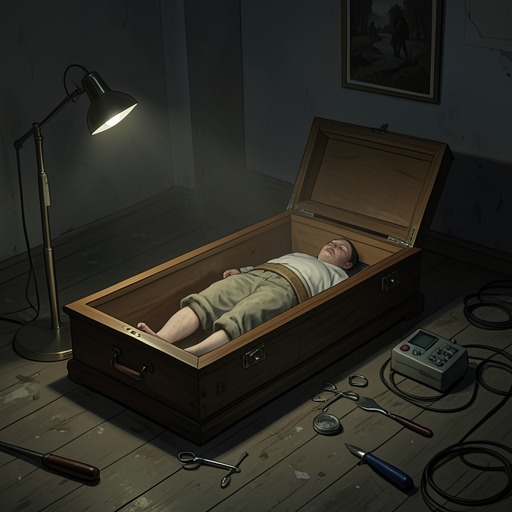
The bodies of Mary and Mary Olive were found in stages of decomposition consistent with the length of time they had been buried. Mercy’s corpse, however, appeared fresh. That appearance was treated as evidence of undead activity, although the circumstances offered a straightforward physical explanation. Mercy had been dead for less than two months, and her coffin had been kept in a crypt because the ground was frozen and too hard to dig. The cold season and the delay in burial could therefore account for the limited decay, but the medical objection did not overcome the community’s supernatural interpretation.
A local doctor examined Mercy’s lungs and insisted that they showed signs of tuberculosis. The disease had been recognised by the medical profession since the early nineteenth century, yet this diagnosis failed to displace the vampire theory. The insistence on a supernatural cause turned the corpse into an object of communal action: Mercy’s heart and lungs were cut out and burned on a pyre built on nearby rocks.
The Failed Cure and Historical Meaning
The ashes of Mercy’s vital organs were mixed with water and given to Edwin as a medicinal concoction, in the hope that consuming them would save his life. The treatment failed, and Edwin died on 2 May 1892. The result did not vindicate the supernatural explanation; instead, it demonstrates how fear could direct medical care toward a destructive ritual even when a doctor had identified tuberculosis in the body being used as evidence.
Mercy’s case belongs to a broader history in which apparently fresh corpses, blood around the mouth, or blood in the stomach were read as signs of vampirism before modern knowledge of decomposition was available. Purge fluid produced by the breakdown of body tissues can collect in the body cavities and escape through the mouth or nose, creating the appearance of bleeding. Other postmortem processes can preserve a corpse or alter its appearance: adipocere, or corpse wax, forms through the anaerobic bacterial hydrolysis of body fats and can leave a body with wax-like features intact. Such processes help explain why a corpse could seem to resist ordinary decay without having returned to life.
Mercy Brown’s story therefore records more than a mistaken diagnosis. It shows how epidemic illness, bereavement, burial practices, and local authority interacted when scientific knowledge could not yet make suffering intelligible to everyone. Folk belief supplied a target for fear and a ritual promise of intervention, but the burning of Mercy’s organs and the administration of their ashes could not halt tuberculosis. Her body remained a symbol of the cost of converting an uncertain disease into a supernatural enemy.
Medical Evidence and Competing Explanations
Mercy Brown’s exhumation illustrates how physical signs could be detached from their medical causes and reorganized into a supernatural narrative. The apparent freshness of her corpse was treated as proof of vampirism, although she had been dead for less than two months, the ground was frozen, and her coffin had been kept in a crypt. These conditions were sufficient to slow decomposition. A local doctor also identified signs of tuberculosis in Mercy’s lungs, but his objections were disregarded when the community preferred the explanation of an undead relative draining the family’s vitality. The same interpretive problem appears in older reports of corpses with blood around their mouths or in their stomachs: purge fluid, produced as decomposing tissues break down, can collect in body cavities and escape through the mouth or nose, where it may resemble blood. Adipocere, formed when anaerobic bacteria hydrolyse body fat, offers another possible explanation for apparently preserved corpses, since corpse wax can give a body a roughly cast-wax appearance while leaving facial features intact. These processes do not prove that every historical vampire account arose from misunderstood decomposition, but they show how ordinary postmortem changes could become persuasive evidence when medical knowledge was limited and fear demanded a visible cause.